Guess how Accelerated Mobile Pages would accelerate your business!!
Any Ideas?
Well, since its inception in early 2016, over 25 million domains have published more than 1.5 billion AMP Pages.
Oh! Wait wait…. But what does AMP litreally mean??
Is it an application? Is it a design? Is it an HTML Framework?
Well to solve this curiosity we intend to search on Google which typically gives its definition according to Wikipedia as
“AMP (originally an acronym for Accelerated Mobile Pages[1]) is a web component framework and a website publishing technology developed by Google which has the mission to “[p]rovide a user-first format for web content”
All right let’s translate from Greek and Latin. Here’s my go at it
AMP is an open source framework developed by Google. Accelerated Mobile Pages create better, faster experiences on the mobile web. Higher Bounce rate are generally being associated with slower loading web pages. Usage of AMP Format would address this problem and would allow people to consume and engage with more content.
But stop right here!!! Is that all to do with Speed and Performance alone?
Promotion with enhanced distribution would yield publishers and advertisers to take advantage of the open web’s potential for the content to appear everywhere quickly across platforms and apps which can lead to more revenue.
Say it again loud……..AMP WOULD LEAD TO MORE REVENUE…….
AMP is
- Easy
- Interactive
- Dynamic
- Increasing the volume of Organic Search Traffic
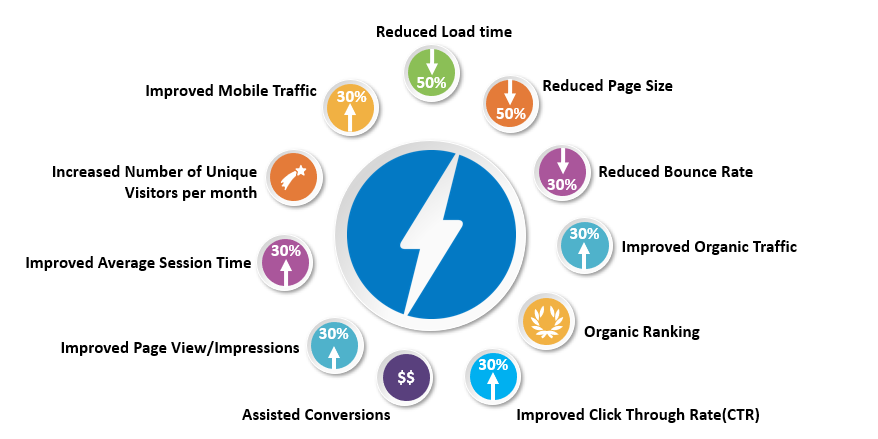
Got it right!!But still hold on!! Basically what do you think on “who can use Accelerated Mobile Pages?”
Well it is open to all the players on the ecosystem. Marketers, Developers, Publishers, Advertisers, Consumer Platforms and creators would find it more useful. To know more about users and usage occasions here it is for you
It’s a google developed HTML Code. AMP provides a rich set of built-in actions for creating interactive websites.AMP offers different ways to render dynamic content on a page. With amp-list it’s possible to client-side render data pulled in from a JSON endpoint.It’s a google developed HTML Code.
Yeah that’s great. But my CMS being a Drupal . How does AMP basically ally with Drupal ?
Well it would provide us it’s help with Drupal AMP Integration comprising of AMP Module and AMP Theme
Basically Node Pages would only be converted onto AMP whereas other pages can be customized to AMP. Style sheets are generally not being used in AMP whereas some rules pertains for AMP
AMP for Drupal basically comes with versions that have been elucidated below:
Version 1:
Cascaded Style sheet of the entire website is loaded in internal Style sheet. It does not support Drupal 8 libraries supported formats . Some of the Drupal 8 supported formats includes:
- AMP Text
- AMP Image
- AMP i-frame
- AMP Video
Theme : A new sub theme needed to be created using AMP theme as base theme
Version 2:
Replicates the same as in Version 1 on all its aspects
Version 3:
Supports Drupal 8 libraries. Thus only page specific cascaded style sheet are included in the internal style sheet. Supported Formats here would include
- AMP Text
- AMP Image
- AMP i-frame
- AMP Video
- AMP Carousel
- AMP Social Post
Blocks would generally include AMP Social Share and AMP System Branding
Theme: Existing Themes can be converted onto a supporting Theme
AMP Version 3 currently follows Alpha version which is ready for use but not readily available
The Version 3 branch of AMP Module is a place to develop experimental new features and functionality for Accelerated Mobile pages
- Make it possible to create an AMP theme that is a subtheme of your normal theme so AMP pages look more like the rest of your pages.
- Make it possible to have an AMP-only site, where the AMP page is the canonical page instead of an alternate page.
What is different in AMP Version 3 for Drupal 8?
1.Schema.Org JSON-LD
AMP requires valid Schema.org JSON-LD to be rendered in the head of AMP pages. That metadata is also used, and useful, in non-AMP pages. And Schema.org includes a huge volume of possible objects and parameters. The original AMP module provided only a couple simple Schema.org parameters, and couldn’t possibly expand to include all of them
2. CSS Rendering and Tools
AMP requires all css to be rendered inline, in the head of the page. Drupal by default either links or imports css. The drupal 8 version 3 branch has a service decorator that massages all Drupal’s css to minimize it and render it inline as AMP requires. That means AMP themes handle css normally, in the same manner as any other theme would do.
3. AMP JavaScript
There have been many new AMP javascript libraries created since this module was first developed. Since AMP whitelists javascript, all of them must be included in the AMP libraries file or they won’t be allowed. This file has been expanded to include all the new libraries and components.
4. AMP Components
The list of AMP components has expanded greatly. Most are provided either as blocks or field formatters. These blocks and formatters are entirely self-reliant, and actually can be used anywhere, even on non-AMP pages, for consistency between AMP and non-AMP page display.
The chances are you are like me when i was on 2016 (without AMP Knowledge) and have made the mistakes above. I know this because you are reading this blog, and I’ve spent the majority of my time blogging on tactics instead of teaching you strategy. AMPs are brainwashed from Day one with majority of them using mobile phones. It find itself suitable for the current generation business targeting the Digital Age target audience
In reality more revenue is what really important and that’s where AMP comes onto place which boosts not only mobile speed but also our revenue.
 Accelerate your business with AMP